

If you run an established business generating $10–25 million a year in revenue, you’ve probably heard some version of the same advice on repeat:
“You just need more leads.”
Maybe it’s from peers, a sales leader, or the latest podcast in your queue. And on the surface, it sounds reasonable. More leads, more sales, more growth… right?
But here’s what I see over and over when I sit down with owners:
The pipeline is fuller than it’s ever been, yet profit hasn’t moved nearly as much. The team is stretched thin. You’re busier, but not necessarily better off.
That’s the misconception: that growth is mainly a lead problem.
In reality, many established businesses are already sitting on a stack of hidden profit inside the operation they have right now. And one of the most practical tools to uncover it is a customer profitability analysis, a simple way to see which customers and services are truly driving profit, and which ones are quietly eroding it.
If you’re feeling pressure to “scale,” but you’re hesitant to throw more money into marketing or headcount without a clear plan, you’re not alone. The owners who grow well are the ones who choose intentional growth over reactive growth.
What Is a Customer Profitability Analysis?
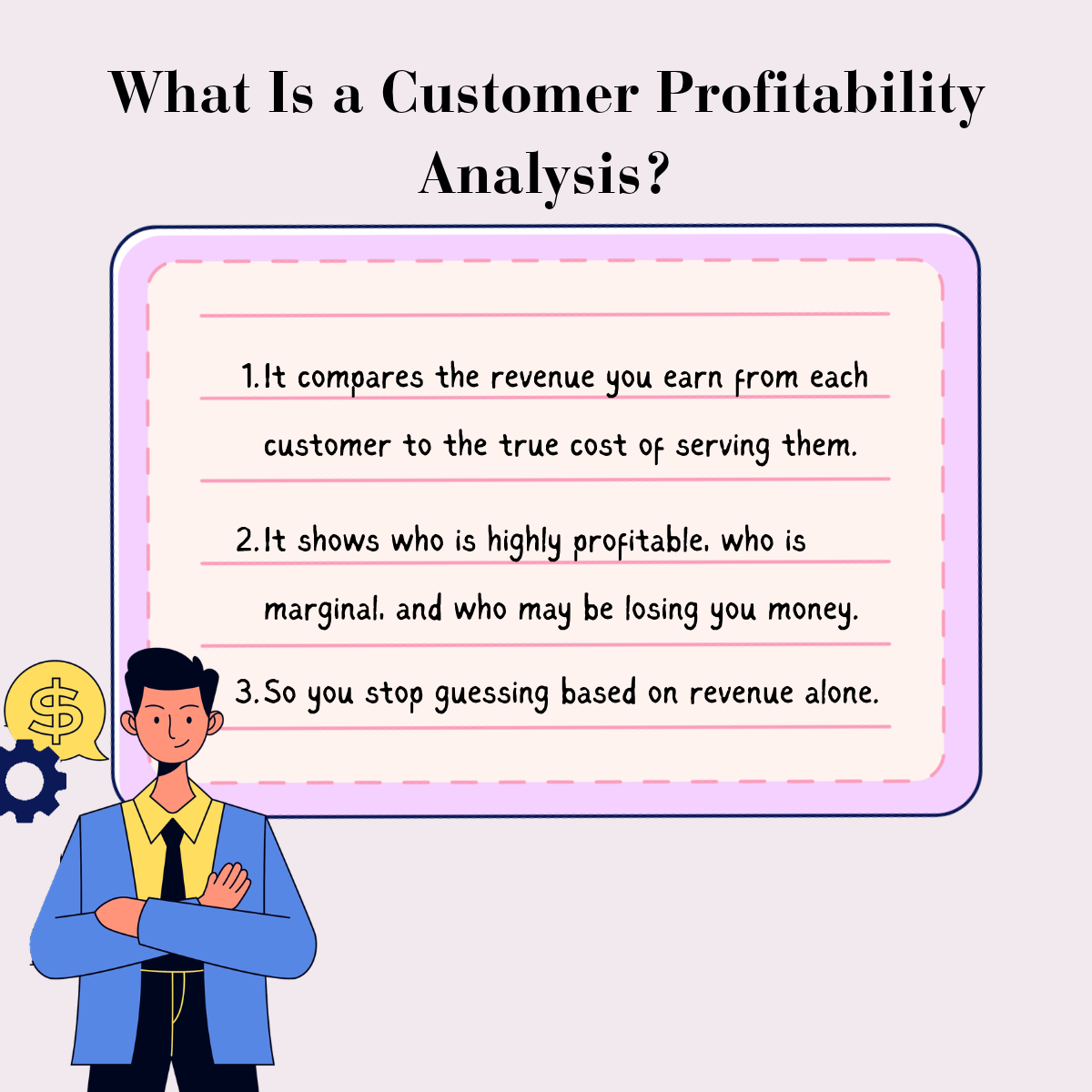
A customer profitability analysis compares the revenue you earn from each customer to the true cost of serving them so you can see who is profitable, who is marginal, and who may be losing you money. Put simply, it answers the question: “Which customers are really worth it once we factor in all the effort and expense?”
Instead of assuming that your biggest customers are your best customers, this analysis gives you a clear, numeric view of where profit is created and where it is slipping away.
Why Revenue Hides Your Least Profitable Customers
When growth feels slow or chaotic, it’s natural to focus on the front end of the business. Turn up marketing. Hire more sales reps. Add new channels. On paper, that looks like momentum.
But if the core economics and operations aren’t healthy, more leads often magnify your problems instead of your profit.
I see a few patterns repeat:
The team is already running hot. Adding more work just creates longer lead times, more mistakes, and more customer frustration.
Margins are thin. So even when revenue rises, very little drops to the bottom line.
Systems are patched together. Every new customer adds friction, manual work, and fire drills.
In that environment, chasing volume is like pouring water into a leaky bucket. You might feel busier, but you’re not building a stronger company.
A customer profitability analysis helps because it shifts your focus from “Who pays us the most?” to “Who pays us the most after we account for what it takes to serve them?” Often, the customers that dominate your revenue reports are also the ones:
Demanding extra customization and scope creep
Pushing for discounts or extended payment terms
Absorbing more senior time and attention than everyone else
That’s why it’s so common to see a large account show up as one of your least profitable once you look at cost to serve.
Customer Profitability Analysis Example
Here’s a simple customer profitability analysis example with five customers. These are not real numbers, but they reflect what I often see in established businesses.
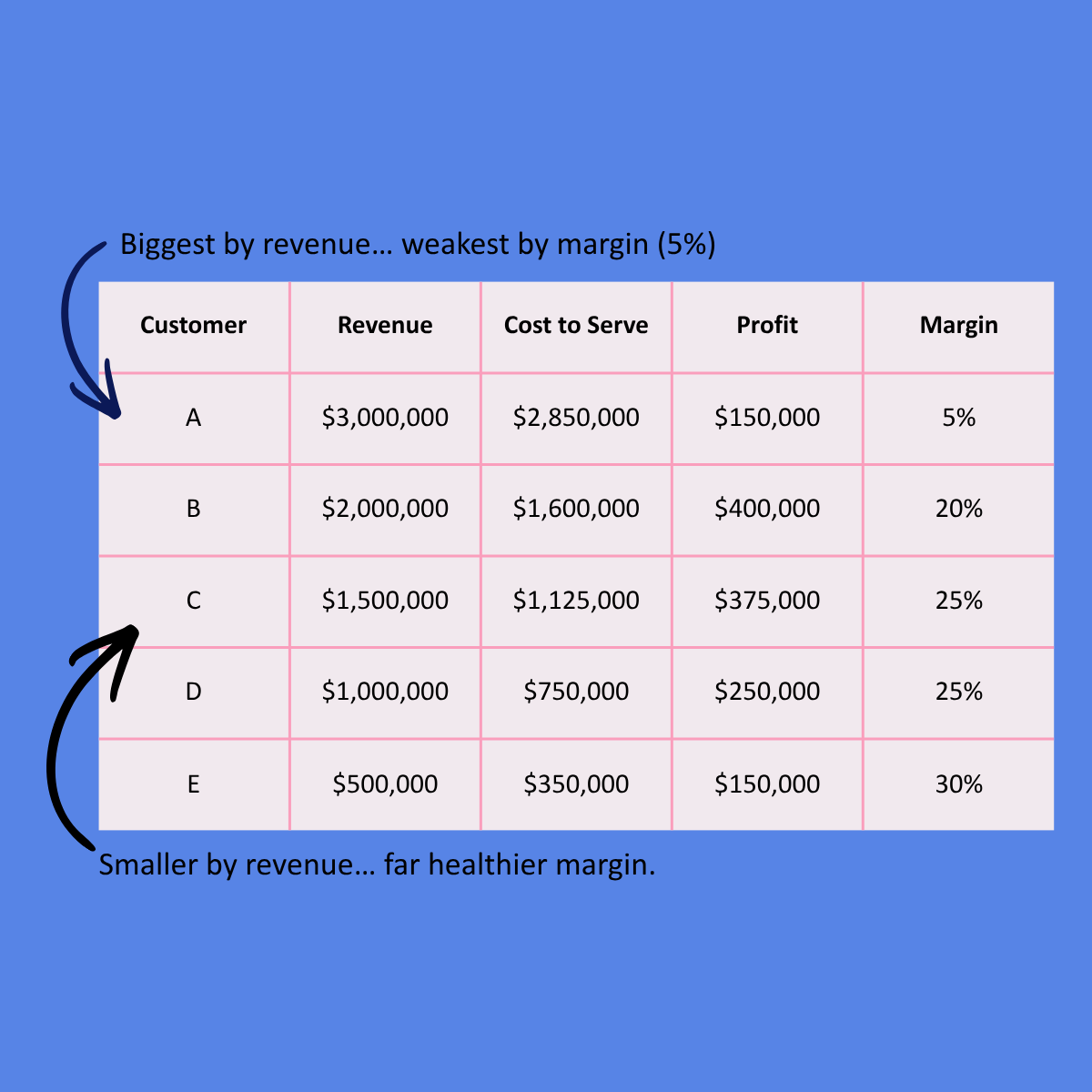
At a glance, Customer A looks like a star: the largest account with the highest revenue. But once you compare revenue to the cost to serve, you see a different story:
Customer A delivers the lowest profit margin at 5%
Customers C, D, and E are dramatically more profitable on a percentage basis
Even Customer B, at a smaller top line, contributes more absolute profit than A
This is where most owners have an “aha” moment. The account everyone is working overtime to keep happy is often the one dragging overall profitability down.
The goal is not to fire every low-margin customer tomorrow. The goal is to understand where you are over-serving, under-pricing, or over-customizing, and then make thoughtful decisions about repricing, renegotiating, or reshaping the relationship.
Service Line Profitability: Which Work Actually Pays
Customer-level analysis is powerful, but it pairs well with service line profitability. Different types of work have different economics, even within the same customer.
For example:
Standard, repeatable services may carry strong margins and smooth delivery.
Highly customized work may require more senior talent, more meetings, and more rework.
Legacy services you “still do for a few clients” may be clogging your pipeline while contributing very little profit.
When you look at service line profitability, you begin to see:
Which services or offerings deserve more focus and investment
Which ones should be repriced, tightly scoped, or phased out
Where your team’s time and energy are being spent on low-return work
This is where owners often find room to simplify the business. So they can do more of the work that truly pays and less of the work that constantly strains capacity.
What Your Gross and Net Margins Are Telling You
A customer profitability analysis connects directly to your margins.
If you notice that your gross margin is consistently lower than it should be for your industry, or that net margin is stubbornly flat despite higher revenue, it’s usually a sign that customer and service line economics need a closer look. The key idea is this: margin trends are often the early warning signal that something is off in who you serve, what you sell, and how you deliver.
What to Do With What You Find
Once you complete a basic customer profitability analysis and look at service line profitability, you’ll start to see clear patterns. From there, you have a few practical levers:
Repricing
Increase prices on consistently underpriced services.
Adjust rates for high-complexity work that is currently priced like standard work.
Renegotiating
Tighten scope and change order rules with customers who constantly expand requests.
Revisit discounts and terms that no longer make sense at your current size.
Phasing out unprofitable work
Gradually exit services that are misaligned with your strategy or always low-margin.
Reposition your offer so you attract more of the high-fit, high-margin customers.
Fixing scope and processes
Clarify what is and isn’t included for each service line.
Standardize handoffs, approvals, and quality checks to reduce rework.
The goal is not to turn your business upside down overnight. The goal is to take one clear step that improves your economics now and sets you up for healthier growth later.
Why Profit Now Is Valuation Later
If you’re planning to sell your business in the next 3–5 years, these decisions matter even more.
Buyers and investors look closely at the quality of your revenue:
Are your best customers also your most profitable?
Do you have a strong mix of healthy, recurring work?
Are margins stable or improving over time?
A customer profitability analysis and a clear view of service line profitability help you shape a business that isn’t just growing, it’s attractive, durable, and easier to value.
Every improvement you make now in customer mix, pricing, and how you deliver doesn’t just increase this year’s profit. It supports a higher multiple and a smoother exit when you’re ready.
This is the work I love doing with established owners: turning a solid business into a stronger one by improving what already exists. If you’re ready to grow, but you want that growth to be intentional and grounded, your next step isn’t “more leads.” Your next step is a focused look inside your business to decide where profit should grow first.