

When Growth Feels Like “We Just Need More People”
You’re at $10–25 million in revenue, demand is real, and your team is tired. Projects are slipping, customers are waiting longer than you like, and every leadership meeting seems to end with the same answer:
“We just need more people.”
It sounds reasonable. More work, more bodies.
But hiring is one of the most expensive and hardest-to-undo decisions you can make. At this stage of growth, it’s very common for “we’re at capacity” to mean something else is broken: margins, workflows, role clarity, or how leaders are spending their time.
This isn’t an argument against hiring. You will almost certainly need to grow your team if you want to grow your revenue. The point is different:
Hiring should be the conclusion you reach after you examine the business—not the starting assumption.
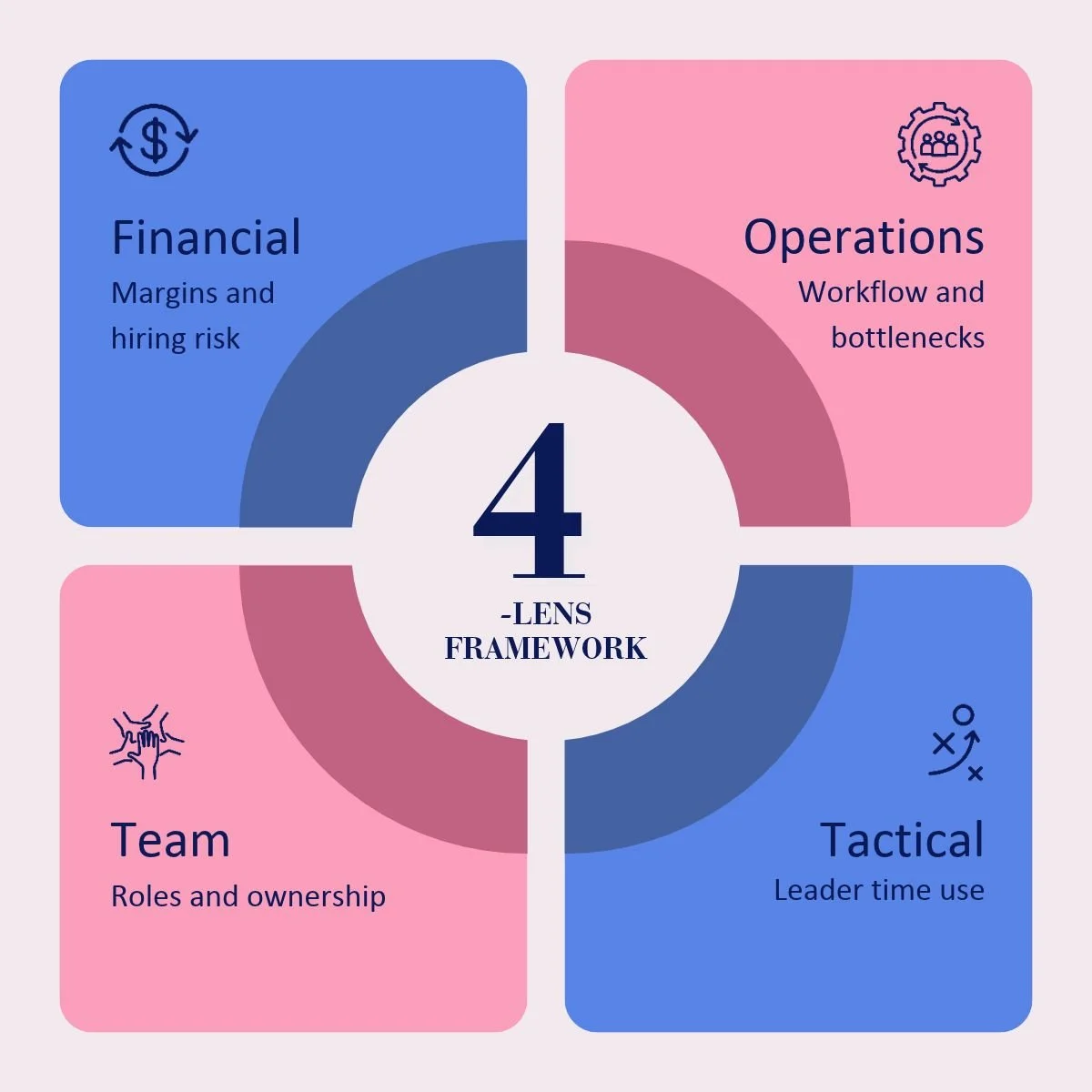
To get there, let’s walk through four lenses: Financial, Operations, Team, and Tactical.
Financial Lens – What a New Hire Really Costs at $10–25M
When someone says “let’s just add another person,” they’re usually thinking in terms of salary.
The business, of course, pays something very different.
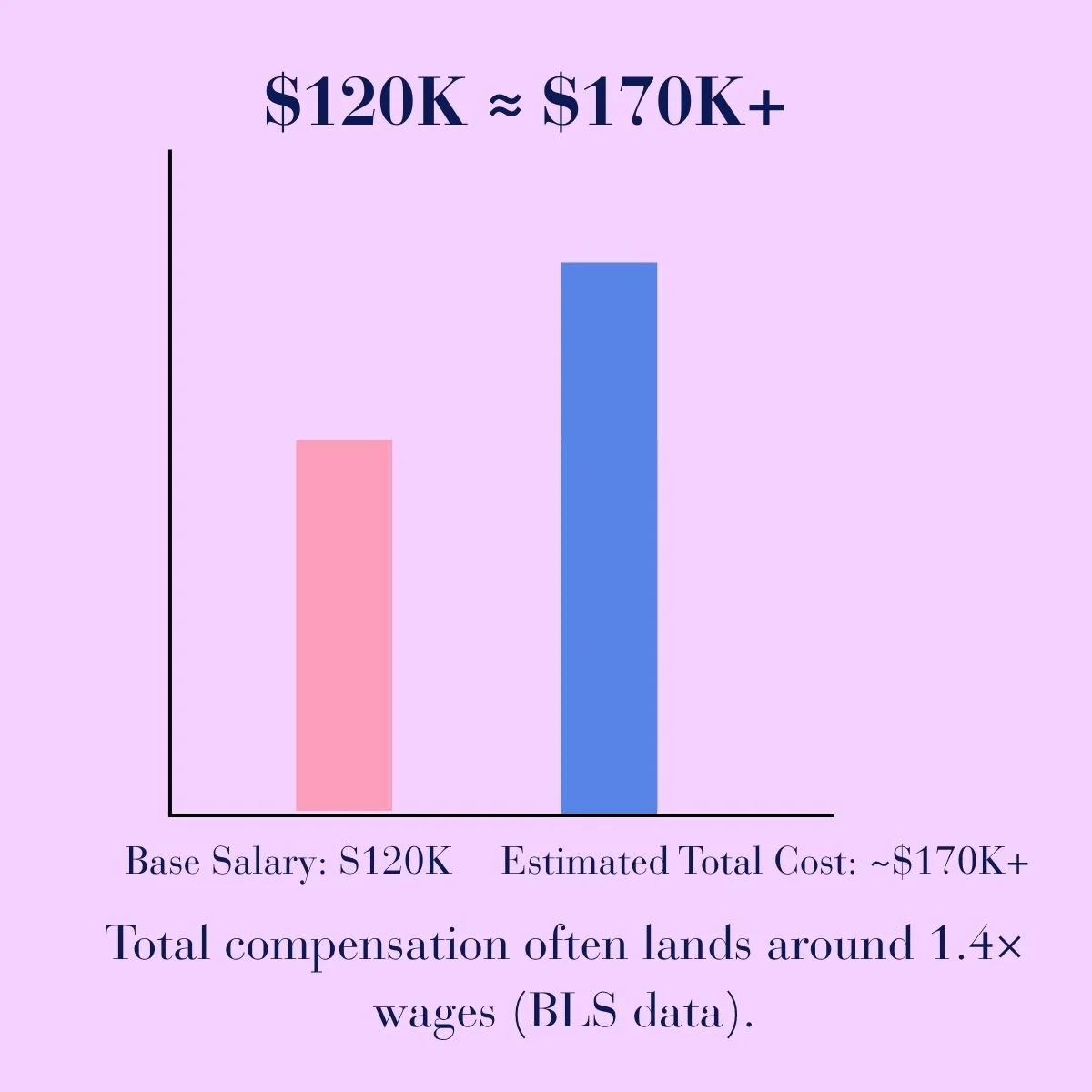
In the U.S., benefits add a lot more cost than most owners instinctively factor in. According to the Bureau of Labor Statistics, private employers spend about $32.60 per hour on wages and another $14.01 per hour on benefits, for a total of $46.60. That means total compensation is roughly 1.4× base wages (U.S. Bureau of Labor Statistics, Employer Costs for Employee Compensation, March 2026).
So when you’re considering a $120,000 hire, your real annual cost often lands closer to $170,000 or more once you factor in benefits, taxes, and overhead—and that’s before they’re fully productive or well-managed.
Before you jump to hire someone new, ask:
Do our current margins comfortably support this role if growth takes longer than expected?
Are we clear on which work, revenue, or savings this person will own?
Is there a pricing or scope problem hiding underneath this “need more people” conversation?
If the numbers don’t work, hiring won’t fix the pain. It just makes it more expensive.
Operations Lens – Is Your System at Capacity, or Just Messy?
There’s a difference between busy and at capacity.
Busy is what happens when work bounces between people, sits in inboxes, or waits on a single decision-maker. Capacity is what happens when a well-designed system hits its true limits, even with clean handoffs and clear priorities.
When you’re feeling the squeeze, take a hard look at:
Utilization: Are people spending most of their time on the right work, or is a lot of energy going into rework, status updates, or chasing information?
Workflows: Where does work stall? Handoffs between sales and delivery? Between delivery and finance? Within a single team?
Bottlenecks: Is there one role, system, or approval that everything queues behind?
A quick, practical move: pick one core process—like onboarding a new client or fulfilling a standard order—and map it step by step. Note where tasks wait, where things bounce back, and where people need to ask for clarification.
If you can remove even one or two bottlenecks in a core process, you often free up the equivalent of half a person or more in effective capacity, without adding a single head.
Team Lens – Role Clarity, Strengths, and Decision Rights
At $10–25 million, it’s common for people to be in “blended” roles that grew organically with the business.
That can work for a while. Then the cracks show up as:
Everyone is “kind of” responsible for key outcomes, so no one fully owns them.
Strong people are in the wrong seats, doing work that doesn’t match their strengths.
Decisions climb back up to the owner because it’s not clear who gets to decide what.
Gallup analyzed more than 112,000 workgroups and found that teams with higher engagement—including clarity of expectations—see dramatically better results: 23% higher profitability, 18% higher sales productivity, and 78% lower absenteeism compared with low-engagement teams (Gallup, The Relationship Between Engagement at Work and Organizational Outcomes, 11th Edition, 2024).
That’s another way of saying: when people know what “great” looks like in their role, they show up stronger, sell more, and miss fewer days.
If your team’s roles and expectations are fuzzy, it can easily feel like you’re understaffed when you’re actually under-aligned. Before you hire, consider:
Does each key function have a clearly defined owner?
Does every leader know exactly which outcomes they’re accountable for?
Do your best people have the authority they need to move work forward?
Sometimes the “capacity problem” is really a leadership clarity problem.
Tactical Lens – Are Your Best People Doing Their Highest-Value Work?
Even in very seasoned organizations, senior leaders spend a surprising amount of time on work that isn’t truly strategic.
A Harvard study that tracked 27 CEOs for nearly 60,000 hours found that they worked an average of 62.5 hours per week—and about 72% of that time was spent in meetings, not deep, strategic work (Michael E. Porter & Nitin Nohria, What Do CEOs Actually Do?, Harvard Business Review, 2018).
If that’s true for large-company CEOs with layers of support around them, imagine what’s happening in a $10–25M business where the owner is still in the middle of everything.
Before you add to the headcount, ask:
How much of my week is spent in meetings, approvals, or firefighting?
How often are my senior leaders pulled into work that someone else could do with better tools, training, or process?
What percentage of our time is going to admin, reporting, or “checking on things” versus high-value work that drives revenue, margin, or strategy?
A simple time audit over two weeks—tracking where your hours really go—can surface a lot of hidden capacity. You may find that your next growth step is redesigning calendars and workflows, not payroll.
When Hiring Is the Right Move
Sometimes, after you’ve worked through these lenses, the answer is clear:
You need more people.
You’ve tightened pricing and improved margins. You’ve cleaned up workflows and removed obvious bottlenecks. Roles are defined, leaders are empowered, and your key people are already focused on high-value work.
And even then, the team is consistently turning down good business, missing opportunities, or working at an unsustainable pace.
At that point, hiring is not a reflex. It’s a strategic decision backed by data.
When you get there:
Define the role based on the specific gaps you uncovered in Financial, Operations, Team, and Tactical.
Tie the hire to clear outcomes: revenue, margin, customer experience, or owner bandwidth.
Set up simple metrics so you can see whether this hire is truly creating the capacity and growth you expected.
You’re not just adding a body. You’re investing in the next level of the business.
A Simple Pre-Hire Checklist for Owners
Before you post that job description, walk through this quick checklist:
Financial
Do our current margins support this hire if growth lags by 6–12 months?
Have we accounted for the full cost (1.4× salary or more), not just base pay?
Operations
Have we mapped the core process where we feel the pain and fixed obvious bottlenecks?
Are we confident we’re not adding a person to a broken workflow?
Team
Is it clear who currently owns this work—and where ownership breaks down?
Will this hire bring true clarity, or just more overlap?
Tactical
Have we audited how leaders spend their time for at least a week or two?
Are there tasks we could eliminate, automate, or delegate before hiring?
If you can answer these with confidence and still feel the squeeze, you’re in a much better position to make a smart, strategic hire.
Grow by Fixing What’s Broken, Not Adding Bodies
You’re not trying to build a bloated company. You’re trying to build a healthy, scalable one.
That starts with understanding what’s really driving the feeling of “we’re maxed out.” When you slow down long enough to examine the financials, the operations, the team, and the way leaders spend their time, your next move becomes much clearer.
If you want help pressure-testing whether hiring is the right next step—or if there’s something else to fix first—let’s look at your business through these four lenses together.