

Execution Is a System, Not a Personality Trait
When “Work Harder” Stops Working
You’re not short on ideas. Or effort.
Your business is in that $10–25 million range because you’ve already done the long nights, the scrappy decisions, the “we’ll figure it out” seasons. But lately, it feels like working harder just produces… more noise. More meetings. More half-finished projects.
Meanwhile, you can probably name a few companies in your space that seem to glide. They announce a new initiative and it ships. They set growth targets and, somehow, they hit them. It’s tempting to think, “They’re just better at execution. Their leaders must be wired differently.”
That belief is powerful and dangerous. Because as long as execution looks like a personality trait other companies were born with, it’s easy to miss the truth: consistent execution is built, not inherited. And that truth sits at the heart of how you execute a business growth plan with confidence instead of hope.
The Myth of the “Execution-Native” Company
From the outside, strong operators look gifted. Their teams move in sync, priorities feel obvious, and big projects move from slide deck to real life. It’s easy to assume there’s something in their DNA you don’t have.
But when researchers look under the hood, they see something very different. McKinsey found that more than one-quarter of leaders said their companies had plans but no execution path, and another 45% said their planning processes didn’t even track execution of strategic initiatives (McKinsey, How to Improve Strategic Planning, 2007).
These aren’t lazy or unimaginative people. They’re smart teams without a clear way to turn plans into movement.
So the gap between “we talk about growth” and “we deliver growth” isn’t about charisma, IQ, or a rare founder personality. It’s about whether the company has designed a business growth system or is still trying to run on effort and intention alone.
What Execution Really Is: A Designed Operating System
Think of execution less like a personal strength and more like your company’s operating system.
An operating system decides how work moves from idea to outcome. It answers questions like:
What matters most this quarter in our business growth plan?
Who owns what?
When will key decisions be made?
How do we keep score?
How do we make sure things don’t slip?
When that operating system is fuzzy, growth feels jerky and risky. When it’s clear, the same people, in the same market, can move two to three times faster with far less chaos.
At its core, a strong execution system is built from a handful of simple elements:
Clear priorities
Named owners
Real timelines
Decision rights
Meeting rhythms
A small, visible set of metrics
Consistent follow-through
None of these require a different personality. They require design. And they’re the same foundations you need when you’re developing a business development strategy that can support the next stage of growth.
The 7 Building Blocks of a Strong Execution System

Let’s break those elements down into something you can see in your own business.
1. Priorities: What matters this quarter vs. “someday”
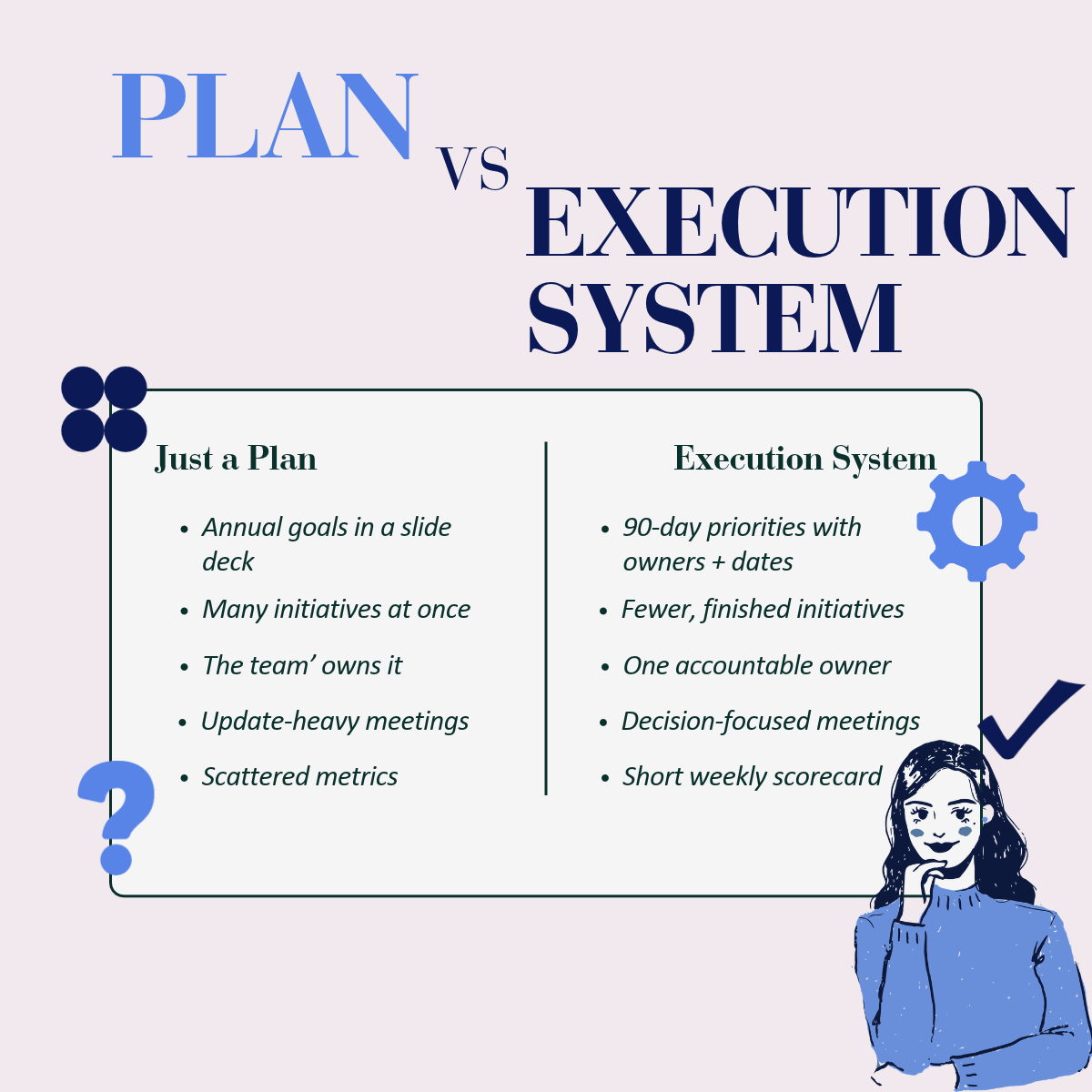
High-growth companies don’t try to do everything at once. They pick a small number of outcomes that matter most in the next 90 days and let the rest wait. When everything is a priority, nothing moves. This is where many owners stall when they try to execute a business growth plan: too many projects, not enough focus.
2. Owners: One accountable person per outcome
If a project has “the team” as the owner, it’s already in trouble. Every key initiative needs one person whose name is on the line for getting it across the finish line, even if many people contribute.
3. Timelines: Specific dates, not vague “soon”
“Q2” and “ASAP” aren’t dates. Strong execution systems tie every major decision and deliverable to clear deadlines. That clarity lets people plan their weeks instead of living in constant fire drill mode.
4. Decision Rights: Who decides, who’s consulted, who executes
When decision rights are unclear, decisions bounce around and stall. Defining who decides, who needs to be consulted, and who executes speeds everything up and lowers friction inside the leadership team.
5. Meetings: Designed to make decisions and unblock work
Most leadership teams meet a lot without moving much. In a healthy operating rhythm, each meeting has a clear purpose: review the scorecard, pick priorities, solve blockers, confirm owners and dates. People leave with decisions made, not just notes captured.
6. Metrics: A simple scorecard visible to the leadership team
An execution system runs on feedback. A short list of 5–7 metrics, reviewed weekly, helps your team see whether your priorities are turning into progress. It’s hard to expand in business when you can’t see what’s working and what isn’t.
7. Follow-Through: How you close the loop every week
Plans don’t fail in the planning; they fail in the follow-through. The power of an execution system shows up when, week after week, someone asks: “What did we commit to? What got done? What slipped? What’s the new plan?”
Each building block is simple. The strength comes from using them together, consistently, as the backbone of how you’re developing a business development strategy and turning it into movement.
How a Weak Execution System Shows Up at $10–25M
At your scale, you feel the cost of poor execution in real money, not just frustration.
The Project Management Institute reported that organizations were wasting 9.9% of every dollar invested in projects because of poor project performance, with high performers wasting far less than underperformers (PMI, Pulse of the Profession 2018: Success in Disruptive Times, 2018). On a $2 million project, that’s nearly $200,000 gone, not because the idea was bad, but because the execution was weak.
You see it in more familiar ways, too:
Revenue grows, but profit and sanity don’t keep up.
Big initiatives start with high energy, then stall in the “in progress” stage.
Your leadership team gets pulled into every decision because roles and decision rights aren’t clear.
Ask three leaders for the top three priorities this quarter and you get three different lists.
When your operating system is shaky, growth feels like a gamble. Every new hire, market, or product adds weight to a structure that already wobbles. Expanding your business under those conditions doesn’t feel exciting; it feels risky.
Designing Your Execution System (Without Becoming a Different Person)
Here’s the good news: you don’t need to turn into a hyper-organized, spreadsheet-loving operator to get strong at execution. You need a simple system that works with how you lead, and a team that knows how to run it.
A practical place to start:
Choose three growth priorities for the next 90 days.
Assign a single owner to each priority.
Set clear timelines and weekly checkpoints. Decide when key milestones land and when you’ll review progress.
Create a 5–7 metric leadership scorecard. Track what really matters for growth and review it every week.
Give every meeting a rule: no meeting ends without clear owners and due dates for next steps.
This doesn’t have to be perfect. The win is moving from “we hope this gets done” to “we have a rhythm that makes sure it does.” That rhythm is what allows you to execute a business growth plan consistently instead of in short bursts of effort.
If you work with a partner in growth strategy consulting, this is the work you should be doing together: not just talking about vision, but building the operating system that delivers it.
Why This Matters for Sustainable Growth
When you treat execution as a system instead of a personality trait, growth starts to feel very different.
You see steady movement toward your targets instead of occasional surges. Your company becomes less dependent on your personal willpower and presence in every room. You can make bigger bets (new markets, new products, new investments) with more confidence because you trust the machine that will deliver them.
Most importantly, the business can stretch without snapping the people inside it. Growth becomes something your team can sustain, not just survive. That’s the path to exponential business growth—not a magic tactic, but a clear operating system that scales with you.
Your Next Step: Audit Your Execution System
If you want a simple way to begin, start with an honest audit. For each of the seven building blocks—priorities, owners, timelines, decision rights, meetings, metrics, follow-through—rate your company from 1 to 5.
Where you see 1s and 2s, you’ve found the bottlenecks to growth. Those are the places your business growth plan and day-to-day reality are out of sync.
If you’d like support turning that insight into a concrete operating rhythm, we can build it together. Let’s design an execution system that matches your ambitions—so your next stage of growth is driven by a clear path, not just more effort, and you can expand in business with far more confidence.
Learn more about The SCOTT Method for Growth Strategies (Strategic Company Optimization and Transition Tactics) or take the Business Growth and Scalability Assessment to determine where you’re at today.