

What are your growth goals for your business over the next three to five years?
If you’re like most owners, you want meaningful growth without grinding yourself into the ground. Yet business owner burnout shows up as long weeks, crowded calendars, and the sense that nothing can move without you. The problem isn’t that you “can’t handle it.” It’s that the structure of the business still relies on you for everything.
This article reframes burnout as a design problem, not a personal failure, and walks through how to reduce owner dependence so your company can grow and, eventually, run without you.
Business Owner Burnout Is a Structure Problem
Burnout for a small business owner rarely comes from one bad week. It’s the cumulative effect of being the decision-maker, firefighter, and safety net for years on end.
One survey of more than 1,000 U.S. small-business owners found that 65% attribute at least one physical ailment to owning their business. Reported effects included muscle tension (55%), stress (53%), fatigue (over 40%), anxiety (42%), headaches (36%), and depression (20%) (Nav, “Mapping Mental Health in Small Business Ownership,” 2026).
Those numbers aren’t about “toughness.” They point to a structural reality: the business is built around the owner.
On paper, you’re the owner. In practice, you’re the head of operations, sales, finance, and customer success, all at once. That’s not sustainable at $10–25 million in revenue. To prevent burnout as a small business owner, we have to change how the business runs, not just how many hours you sleep or how often you take a weekend off.
Signs Your Business Depends on You Too Much
Owner dependence is easy to miss because it looks like “being a good leader.” Here are common business owner burnout signs that point to a deeper structure issue:
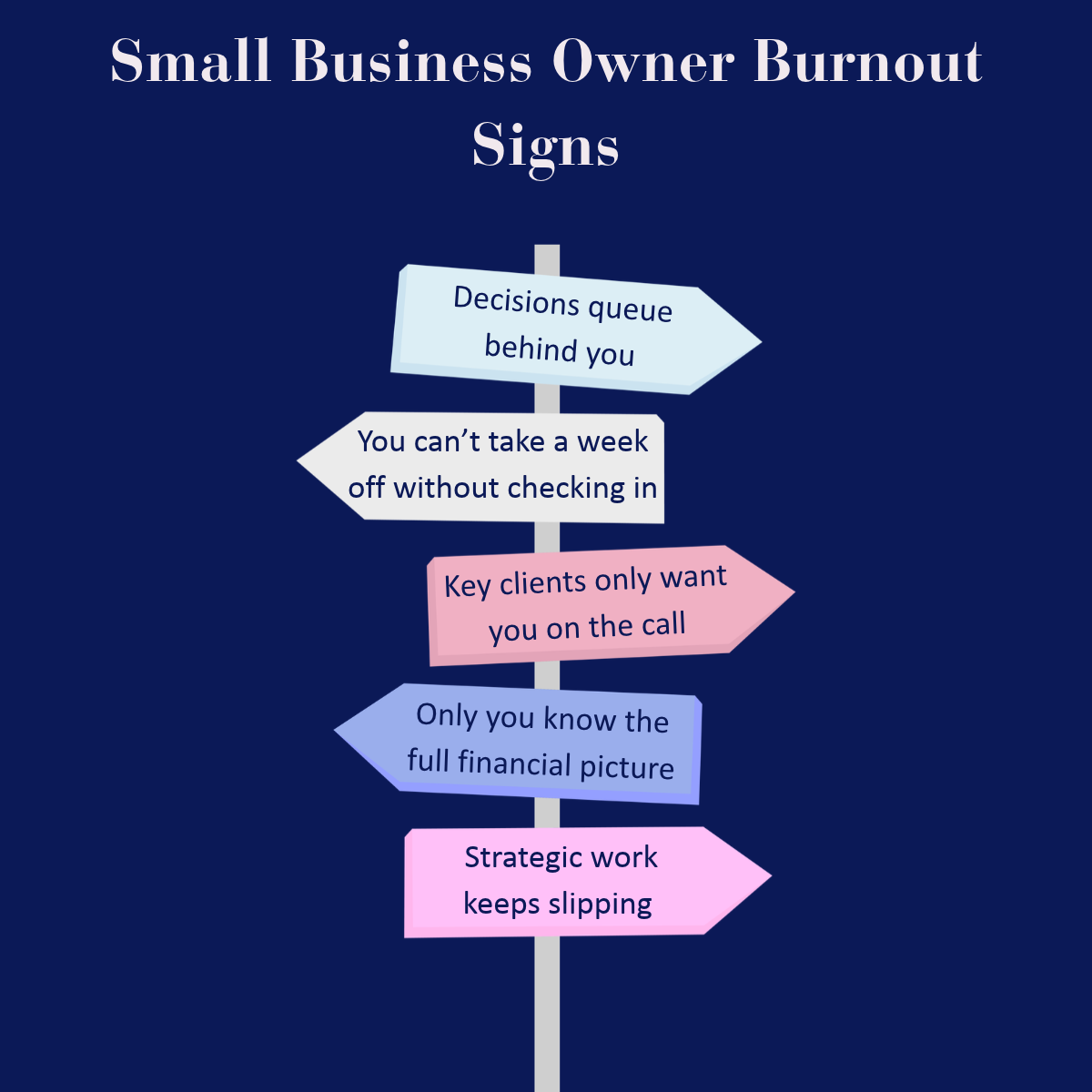
Decisions wait for you. Projects stall until you weigh in on pricing, hiring, scope, or exceptions.
You can’t take a real week off. If you’re honest, more than two or three days away feels risky. You’re still checking email, taking calls, or stepping into issues.
Clients only want you. Key customers ask for you by name. They’re unhappy if someone else handles their account, even when your team is capable.
Only you know the numbers. You carry the financial picture in your head. Others see revenue or costs in isolation, but not the whole story.
You’re the default problem-solver. When something important goes wrong, the team’s first instinct is, “Let’s take it to you.”
Strategic work keeps slipping. Growth plans, new markets, major hires—they keep getting pushed to “next quarter” because the day-to-day eats your time.
Everything feels choppy. Revenue may be growing, but it feels effortful and fragile, as if progress is earned through your personal sacrifice.
If several of these hit home, you’re not just tired, you’re seeing the cost of a business model built on owner dependence.
How to Stop Being the Bottleneck in Your Business
If you’ve been the hub for years, it’s natural to ask how to stop being the bottleneck in your business without breaking what works.
It starts with a clear diagnosis: your burnout and your company’s chaos are two sides of the same coin. Both come from the business relying on one person for too many decisions, relationships, and approvals.
Once you see that, you can treat this like any other business problem:
Define the outcome. For example: “Within three years, this business should be able to grow without me in every decision and every client relationship.”
Map the current state. Look at your last three weeks of calendar and email. Highlight anything that required your approval, problem-solving, or “just this once” exception. That’s your owner-dependence map.
Choose where to change first. Start with areas where shifting decisions off your plate would both reduce stress and improve scalability: pricing approvals, hiring, large-client issues, or operational exceptions.
How to Delegate as a Business Owner (Without It Bouncing Back)
Many owners try to solve business owner burnout by delegating faster. But if roles, expectations, and authority aren’t clear, the work boomerangs right back to you.
Here’s how to delegate as a business owner so it sticks:
Delegate outcomes, not tasks.
Instead of, “Handle this client issue,” try, “Your goal is to retain the client on terms that keep this account profitable. Here are the boundaries. You own the solution.”Be explicit about decision rights.
Tie decisions to thresholds:Below a certain dollar amount or risk level: your leader decides and informs you.
In the middle zone: they recommend, you approve.
At the highest level: you decide, with their input.
Support the first few reps.
Stay close for the first few decisions in a new area. Debrief what worked, where they hesitated, and what decisions they can fully own next time. This is how you prevent burnout as a small business owner and build leaders who don’t bounce every issue back to you.
Delegation that sticks is less about your willingness to “let go” and more about the structure that supports your team to own real outcomes.
Building a Leadership Layer That Can Run Without You
To reduce business owner burnout in a meaningful way, you eventually need a leadership layer that can run without you in the middle of everything.
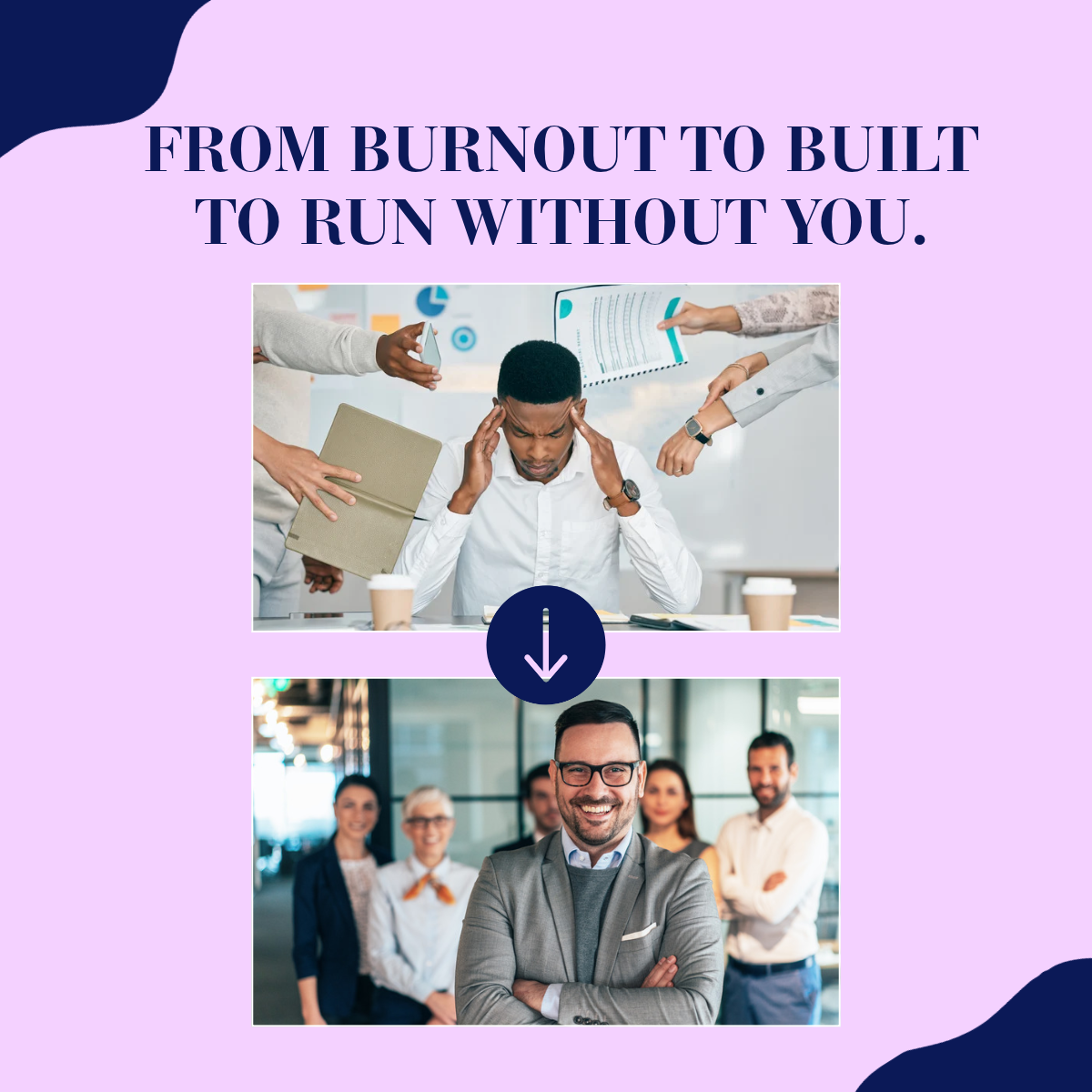
That doesn’t mean disappearing. It means:
Defining a small set of core leadership seats (sales, operations, finance, people, maybe product/delivery).
Putting capable people in those seats, with clear outcomes and authority.
Creating a regular leadership rhythm, weekly and monthly meetings where they bring you insights and recommendations, not every raw problem.
Over time, this leadership layer becomes the engine that keeps the business moving, even when you’re not in every room.
Why Buyers Pay Less for Owner-Dependent Businesses
Owner dependence doesn’t just create small business owner burnout today. It also slowly reduces what your company is worth tomorrow.
From a buyer’s perspective, owner dependency lowers business valuation because:
Revenue and relationships are tied too tightly to one person.
Key decisions, pricing, and problem-solving live in your head.
There’s no proven leadership team or system that survives an ownership change.
Even if you’re not planning to sell soon, this matters. A business that can run without you is more transferable, more resilient, and more valuable. Reducing owner dependence is one of the most direct ways to protect and grow owner dependency business value.
Where to Start This Quarter
You don’t have to fix everything at once. To prevent burnout and improve valuation, start with three moves this quarter:
Do a three-week owner-dependence audit.
Look back at your calendar and inbox. Tag every item that required your approval or rescue. Pick one category (for example, pricing exceptions or hiring) to shift off your plate first.Clarify and assign one leadership seat.
Choose the seat you’re informally sitting in, often head of sales or operations. Define the outcomes and decisions for that role, then decide whether someone on your team can step into it with support, or whether you need to hire.Build a simple owner dashboard.
Identify a handful of metrics that tell you whether the business is healthy: revenue, margin, pipeline, delivery quality, cash. Set a weekly or monthly rhythm where your team reports on these, so you can see what matters without being in every decision.
Over time, these steps reduce owner dependence, ease business owner burnout, and make your company more scalable and valuable.