

Stuck at This Level? Rethinking How to Grow Your Business

You’ve built a good business, but lately it feels like you’ve hit an invisible ceiling. Revenue isn’t declining, but it isn’t meaningfully growing either.
So you ask the question almost every owner asks at some point:
”How do I grow my business from here?”
Most of us assume the answer is simple: We need more leads!
Sometimes that’s true. But often, it isn’t.
One national survey found that roughly 80–90% of small businesses struggle with cash flow at some point, even when revenue is growing. Owners feel squeezed, not because they’re lazy or unambitious, but because the way money, work, and decisions move through the business hasn’t caught up with its size.
If cash feels tight, your calendar is packed, and your team already feels stretched, pouring more leads into the system could actually make things worse.
Before you try to break through your revenue ceiling, you need to know what's creating it. Let's look at the four hidden growth ceilings I see most often, and a simple way to tell whether you need more leads or a different growth strategy altogether.
Four Growth Ceilings That Sabotage Your Business Development Strategy
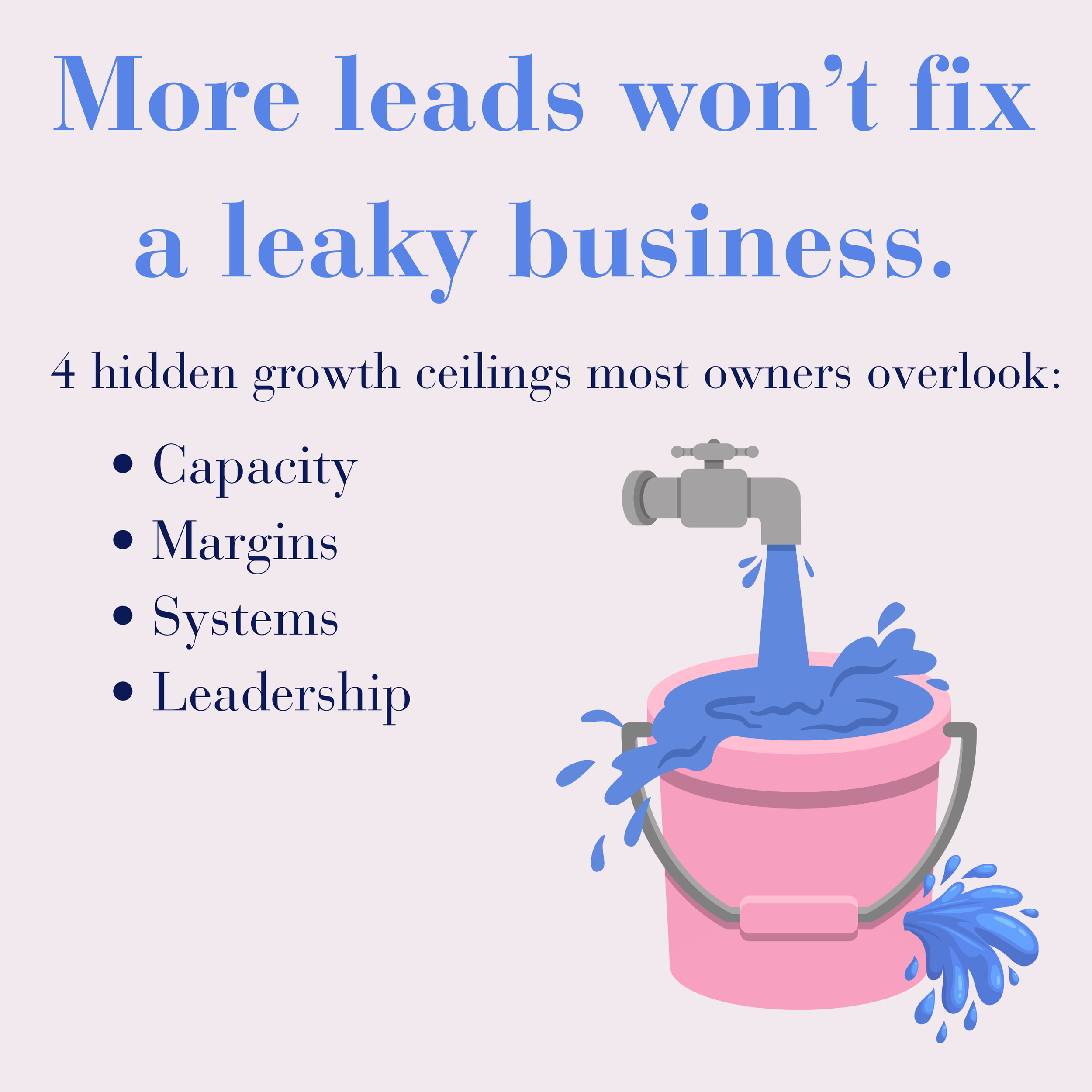
If your business development strategy is focused only on getting more leads, it’s easy to miss the ceilings that keep your business stuck. In owner interviews and growth research, a few patterns repeat:
Businesses tend to hit predictable growth plateaus as they become more complex.
Owners are working 60–70 hours a week.
“More growth” often feels like “more chaos.”
Those are usually signs that the business has outgrown the way it's currently operating, not that there's a lack of demand for what you sell. Here are four of the most common.
Capacity & Delivery – When You Can’t Grow Your Business Because the Team Is Maxed Out
Sometimes the ceiling is simple: there just isn't any room left. Your team is already stretched, projects are stacking up, and you're beginning to see the effects in slower turnaround times and inconsistent quality.
Signs you’re here:
You dread adding more work.
Your best people are constantly firefighting.
In this situation, trying to grow your business with more leads just pours extra volume into an overloaded system. That’s a capacity and delivery problem, not a demand problem.
Margin & Pricing – The Hidden Blocker in Company Strategy Development
Another ceiling hides in your margins. On paper, revenue looks decent, but profit and owner pay don’t move.
Signs:
Your most popular services have the thinnest margins.
Discounting, over‑servicing, and one‑off custom work are common.
In one consulting case, an agency discovered they had to replace around 60% of their revenue every year just to stay flat because low-margin work quietly churned. More leads didn’t solve that; they just poured new work into a leaky bucket.
Healthy company strategy development starts with identifying which services and clients are truly profitable.
Systems & Scalability – The Missing Link in Strategy and Business Development
Here, the ceiling is how work moves through your business.
Processes live in people's heads, hand-offs are inconsistent, and the tools you're using don't really communicate with one another. As a result, even a small increase in volume can create significant stress.
Operations experts often note that companies begin to "fracture" as they grow when their processes haven't matured along with them.
Even the best growth strategy can't overcome fragile systems. More leads simply expose the cracks faster.
Leadership & Decisions – Why Your Business Growth Strategies Stall at the Top
Finally, there’s the leadership ceiling.
Everything still runs through you, and your managers - if you have them - may not have the clarity or authority they need to make decisions on their own. Before long, important decisions begin to bottleneck at the top.
Many owners realize they've put good, loyal people into leadership roles before giving them the training, structure, or authority they need to succeed. They care deeply about their team, but the organization simply hasn't evolved at the same pace as the business.
When that happens, even smart growth strategies stall because the organization can't make decisions quickly and confidently enough to keep up.
A Simple Test: Leads Problem or Business Development Growth Strategy Problem?
Before you pour more money into marketing, it helps to know what you’re actually fixing.
Use this quick test to see whether you really have a lead problem or a business development growth strategy problem.
Step 1 – The Demand Check
Ask yourself:
When good leads come in, do we close a healthy percentage?
Have there been months where demand felt strong, but we still didn’t move the needle much?
If:
Win rates are decent,
You’re getting a reasonable number of opportunities,
But revenue still feels stuck…
…then “no leads” probably isn’t the core issue.
Step 2 – The Stress & Capacity Check
Next, imagine this:
If we got 20–30% more work over the next quarter, would we feel excited or worried that something would break?
If your honest answer is “worried” or “terrified,” that’s a signal.
It usually means you’re up against a ceiling in:
Capacity and delivery
Margins and pricing
Systems and scalability
Leadership and decisions
In other words, you’ve got a business development growth strategy issue, not a marketing issue.
It’s hard to see this from the inside. In one national survey, over 80% of business owners said they rely on financial professionals to guide decisions, precisely because diagnosing these patterns alone is difficult.
If both demand and capacity feel confusing, that’s a sign you need a more holistic look at your business development strategy, not just another ad campaign.
What to Do Instead of Buying More Leads: Smarter Company Development Strategy
If “more leads” isn’t the real issue, you don’t need a total overhaul. You need a clearer company development strategy that fits where your business is today.
1) Define Your Next Level
Get specific about:
Revenue and profit targets
How you want your own time to look
This becomes the foundation for any company strategy development work.
2) Read Your Numbers for Growth
Look at a P&L by revenue streams:
Which services or clients are truly profitable?
Where are margins too thin?
This is what a good business growth strategist does - turns numbers into a clear story about what to stop, start, or change.
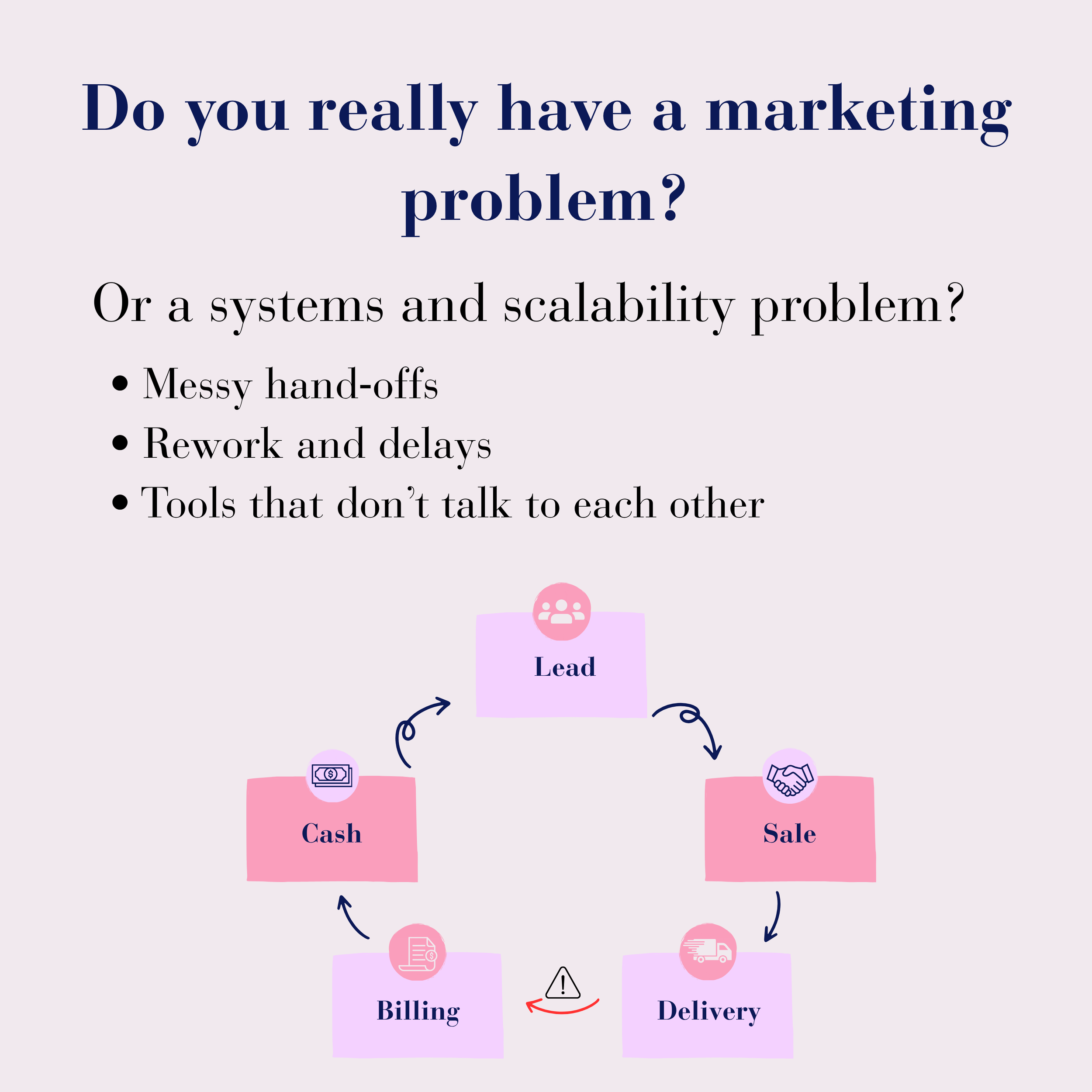
3) Map One Project from Lead to Cash
Sketch how a typical client moves through the business.
Ask: Where does work slow down or get reworked?
Often, what looks like a “sales problem” is really a structure problem. Fixing that improves your business development strategy more than another ad campaign.
Even one small change here can make future lead‑gen much more effective.
How a CPA‑Led Business Growth Strategist Helps You Choose the Right Levers
Once you see there are multiple ceilings you could tackle, the hard part is knowing where to start. That’s where working with the right partner matters.
A good business growth strategist doesn’t just shout “more leads.” They help you decide:
Do we need better demand?
Or do we need better margins, systems, and leadership to support the demand we already have?
In the SCOTT Growth Ceiling & Scalability Assessment, we look at:
Your financials (what your numbers are really saying)
Your systems and capacity (how work moves)
Your team and leadership (how decisions get made)
The goal is a realistic business development strategy you can trust, so when you do invest in growth, you’re pulling the right levers in the right order.
Rethinking How to Grow Your Business
If you’ve hit a revenue ceiling, it doesn’t mean you’ve failed. It often means you’ve simply outgrown the first version of your business.
You’re not alone. Some studies suggest that around 80% of entrepreneurs report impostor feelings at some point, especially when things get more complex.
The most powerful way to grow your business may not be to get more leads. It may be:
Stronger margins
Better systems
Clearer leadership and decisions
Whether you explore this on your own or through the SCOTT Growth Ceiling & Scalability Assessment, the goal is the same: a business development growth strategy that fits your real world, not just more noise at the top of the funnel.
If any of this sounds uncomfortably familiar, your next step might not be a new campaign. It might be taking an honest look at what's really holding your business back.